
News Summary · 4 minutes read
Stay ahead in your UPSC CSE preparation with our daily News Summary. Designed to save time, it highlights key national and international events from leading newspapers and government websites.
7 States contribute more to total taxes than their share in devolutions (FY 2020-21 to FY 2024-25)
- Uttar Pradesh contributed just 4.6% to total tax collections but received 15.8% of the Centre’s tax devolution → highest positive difference.
- Top 3 States where the share in tax devolution exceeds the contribution in tax collection: UP > Bihar > MP.
- Maharashtra contributed 36.1% to total tax collections but received only 6.65% of the Centre’s tax devolution → biggest negative difference.
- 7 states contribute more to tax collections than their shares in tax devolution: Maharashtra > Karnataka > Haryana > Gujarat > Tamil Nadu > Telangana > Goa.
- 15th Finance Commission (FC), headed by N K Singh,did not include the States’ contributions to central taxes as a criterion when it suggested the devolution formula for the period FY 2020-21 to FY 2025-26.
- 6 criteria suggested by the 15th FC for tax devolution were: population, area, income distance, demographic performance, forest & ecology, and tax & fiscal efforts.
- 16th FC, headed by Arvind Panagariya, is tasked with deciding the devolution formula for the period FY 2026-27 to FY 2030-31 → new formula will come into effect from April 1, 2026.
Scrub typhus
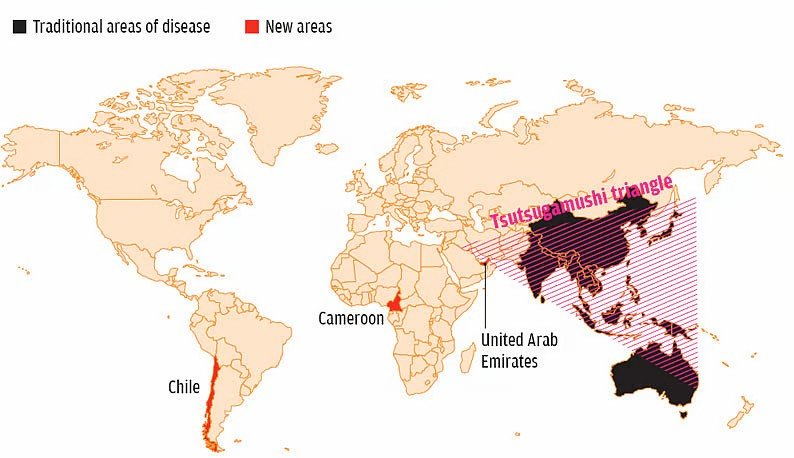
- A bacterial infection caused by Orientia tsutsugamushi.
- Transmitted via bites from larval mites (chiggers) in scrub vegetation, especially post-monsoon in the Asia-Pacific “tsutsugamushi triangle.”
- Can cause multi-organ failure and death, if untreated.
- Cases have surged recently in many South Indian States, including Andhra Pradesh, Tamil Nadu, Karnataka, and Telangana.
Neurotechnology
- A technology that utilises advances in neuroscience, AI, engineering, and computing to create a Brain-Computer Interface (BCI) that can record, monitor, or even influence neural activity → can sense or stimulate brain signals in real time.
- BCI: blends neuroscience and computing to translate thoughts into action → can turn brain signals into digital commands that control a computer cursor, a wheelchair, or even a robotic arm.
- Applications of BCIs range from R&D and disease treatment to military activities, which involve several ethical considerations.
Significance for India
- India carries a significant neurological disease burden: strokes, spinal cord injuries, Parkinson’s disease and depression.
- Neuroprosthetics could restore mobility and communication for those living with paralysis.
- For mental health patients, targeted neural stimulation offers the possibility of reducing long-term dependence on medication.
- Neurotechnology sits at the intersection of biotechnology, engineering, and AI, and has a wide range of applications in healthcare, gaming, and recreation → important not only from a healthcare perspective but also as an economic opportunity.
- India’s genomic diversity and available expertise position India as a potential hub for its development.
India’s position
India is developing academic and private-sector strengths in neurotechnologies.
- IIT Kanpur recently unveiled a BCI-based robotic hand that could be useful for stroke patients.
- The National Brain Research Centre (Manesar) and the Brain Research Centre (IISc, Bangalore) are leading research centres for neuroscience.
- Dognosis, a startup, is studying brain signals in dogs when they smell cancer in human breath samples → potential to revolutionise cancer screening in humans.
Way forward
- Key technical and ethical aspects and their interlinkages should be assessed to ensure data privacy and user autonomy, and avoid unethical practices.
- Adequate regulatory support should be provided to foster BCI development and adoption.
- Public engagement is needed to discuss the benefits and risks of BCIs and to understand public perception of these technologies.
- Instead of a singular policy for all BCIs, tailored regulatory pathways for the different types of BCIs based on their benefits and risks.
Quick Picks for Pre and Mains (QPPM)
- India Post’s DHRUVA framework is expected to promote effective governance, inclusive service delivery, and enhanced user experience. Read about DHRUVA in detail HERE.
- Parliament (Lok Sabha + Rajya Sabha) has passed the Health Security se National Security Cess Bill.
- Cess as the percentage of the gross tax revenue in FY26 is estimated to be 6.1%.
- Mon Edition of Hornbill Festival (December 8-10, 2025): 1st district-specific version of International Hornbill Festival, held in Mon district of Nagaland to promote Konyak tribal culture → inaugurated virtually by Union Culture and Tourism Minister Gajendra Singh Shekhawat.
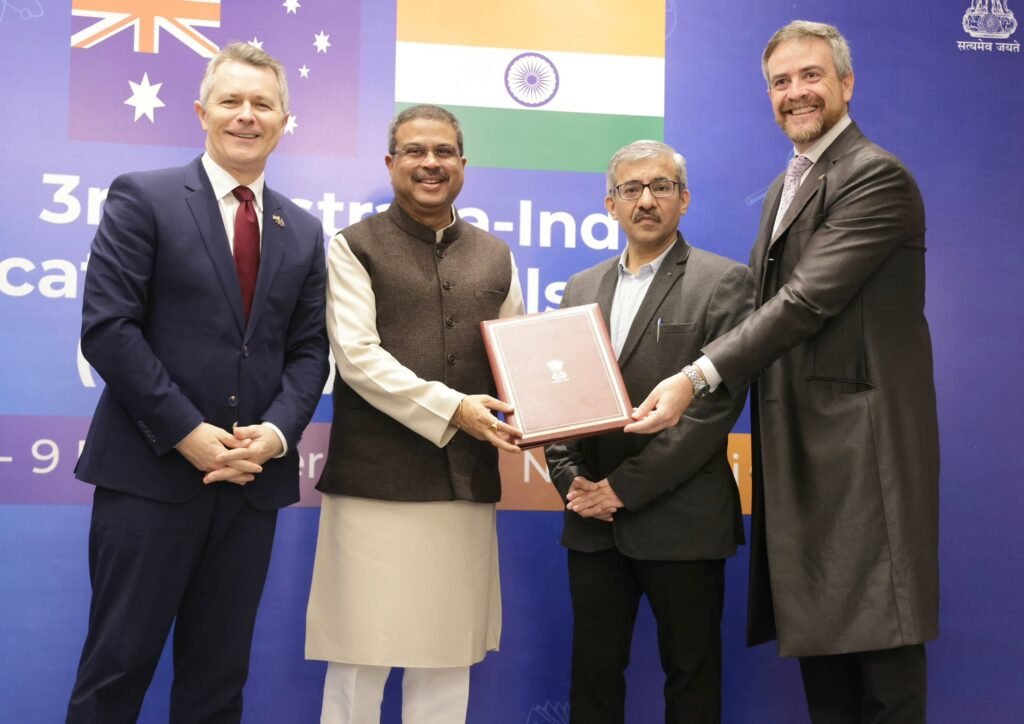
- University of New South Wales (Australia) is set to open its campus in Bengaluru → will be the 7th Australian university to open a campus in India.
- South Kordofan state: Sudan
- E3 group: an informal diplomatic coalition of France, Germany, and the United Kingdom focused on foreign policy and security coordination.
- 28-point peace plan: a US-brokered draft proposal to end the Russia-Ukraine war.
- Yellow Line: temporary border between Israel and Gaza decided under the US-brokered 20-point Gaza peace plan → divides the Israeli-controlled majority of Gaza from the rest of the territory.