
News Summary · 6 minutes read
Stay ahead in your UPSC CSE preparation with our daily News Summary. Designed to save time, it highlights key national and international events from leading newspapers and government websites.
India’s silk industry
- India is the 2nd largest producer and largest consumer of silk in the world.
- India aims for doubling its silk value chain to 110k crore by 2030 (currently pegged at ₹55k crore).
- India produced over 41k metric tonnes of raw silk in FY 2024-25, of which over 70% was mulberry silk, while the remaining was eri, taser and muga → expected to produce 54k metric tonnes by 2030.
- Mulberry silk is produced mainly in the states of Karnataka, Andhra Pradesh, Tamil Nadu, Jammu & Kashmir and West Bengal.
- India exported silk worth ₹2,300 crore in FY 2024-25 and is expected to cross ₹2,500 crore in FY 2025-26.
- Central Silk Board: a statutory body established in 1948 → functions under the Ministry of Textiles with headquarters in Bengaluru → responsible for the overall development of India’s sericulture.
Acid attacks in India
The number of reported cases of acid attacks has been increasing in India: 176 in 2021, 202 in 2022, and 207 in 2023 (NCRB). The crime is underreported due to societal stigma, family pressure, and fear of retaliation. Three worst-affected States (2023): West Bengal > Uttar Pradesh (31) > Gujarat
Legal safeguards
- Section 124 of the Bharatiya Nyaya Sanhita
- Minimum 10 years of imprisonment, extendable up to life.
- Fine to meet the victim’s medical expenses.
- 5-7 years’ imprisonment for an acid attack attempt
- Laxmi v. Union of India (2013)
- Supreme Court mandated a minimum ₹3 lakh compensation for acid attack survivors, with ₹1 lakh payable within 15 days and the balance within 2 months.
- Banned the over-the-counter sale of acid and mandated the regulation of acid sales, with a photo ID for buyers, and sellers required to keep a register of purchases.
- All public and private hospitals must provide free immediate treatment to victims before referring them to a specialised facility.
- In 2015, SC directed that district legal services authorities would function as criminal injuries compensation boards.
- In 2025, SC gave acid attack victims the liberty to approach the State or district legal services authorities or the legal services committee in case there was a delay in payment of compensation.
Implementation Challenges
- Incomplete Payments: Survivors receive initial ₹1 lakh but not the full ₹3 lakh.
- Hospital Non-Compliance: Private facilities refuse free treatment until full payment, defeating immediate care mandates.
- Systemic Delays: Despite repeated orders, States fail to make timely disbursement.
Way forward
- Sale of acid needs to be controlled more comprehensively.
- Stricter implementation of the existing rules.
- Sensitisation of police, public prosecutors, and judges.
- Fast-track courts.
- Legal support and counselling for victims
- Penalisation of judicial delays
- Implementation of the suggestions given by the Justice J.S. Verma Committee (2012-13) → creating national and state-level funds to cover the lifelong medical, psychological, educational, and skilling needs of survivors to ensure comprehensive rehabilitation.
Suryastra
- India’s first indigenously manufactured universal multi-calibre rocket launcher system, for surface-to-surface strikes.
- Universal multi-calibre launcher: a modular Multiple Launch Rocket System (MLRS) designed to fire rockets of different calibres, types, and ranges from the same platform using interchangeable Launch Pod Containers (LPCs) → can handle both guided and unguided rockets.
- Range: 150-300 km
- Precision: Circular Error Probable (CEP) under 5 meters, allowing high-accuracy hits.
- Developed through a partnership between Pune-based NIBE Ltd. and Israel’s Elbit Systems → a July 2025 technology collaboration agreement with Elbit ensures full-scale manufacturing at NIBE’s Pune facility, with technology transfer from Elbit Systems.
- Recently, the Indian Army has, under emergency procurement provisions, signed a ₹293 crore contract with NIBE Ltd. for Suryastra launchers, associated equipment and ammunition.
- Emergency procurement provisions were introduced in 2020 to allow Vice Chiefs of the three services to approve urgent buys up to ₹300 crore, bypassing standard procedures.
Grand International Exposition of Sacred Piprahwa Relics
- Inaugurated by PM Modi in New Delhi on 3 January 2026.
- Title is “The Light and the Lotus: Relics of the Awakened One.”
- Sacred Piprahwa Relics of Buddhawerediscovered in 1898 by William Claxton Peppé at the ancient Piprahwa stupa site in Siddharthanagar, and portions were distributed as follows:
- 1st part: gifted to the King of Siam/Thailand.
- 2nd part: taken to England by Peppe and stayed with his family → repatriated to India in 2025
- 3rd part: preserved at the Indian Museum, Kolkata.
- New Delhi’s 2026 exposition commemorates the reunification of the 2nd and 3rd parts of the relics mentioned above, along with the findings from the 1972-75 Piprahwa excavations (led by K M Srivastava), which were preserved at the National Museum, Delhi.
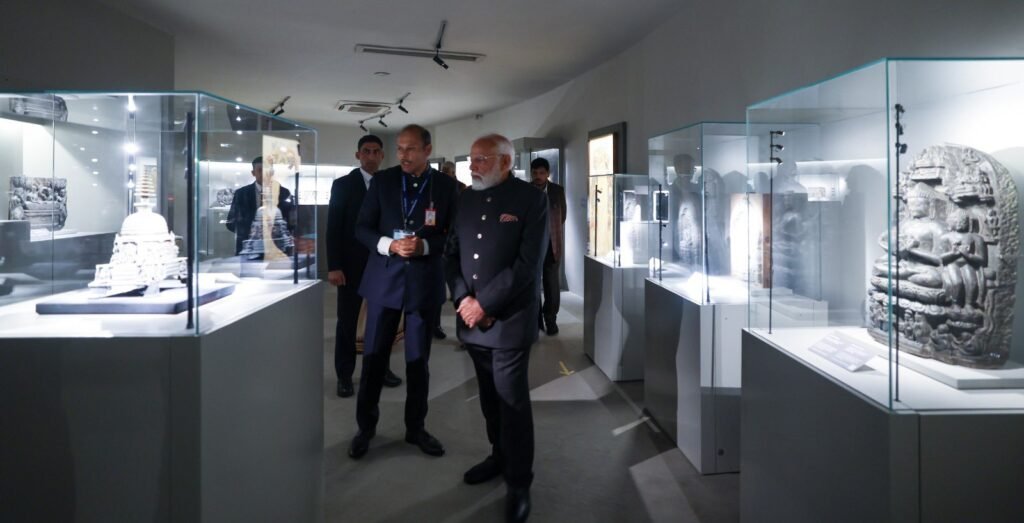
PM Modi at the Grand International Exposition of Sacred Piprahwa Relics in New Delhi on 3 January 2026. Photo: X/@MinOfCultureGoI
India’s live events industry
- Emerging as a key contributor to India’s media and entertainment ecosystem → was valued over ₹20k crore in 2024.
- Has vast potential to generate employment, attract investment, boost tourism, and enhance India’s cultural influence globally.
- Poised to position India among the leading global live entertainment destinations by 2030 with an expected CAGR of 18%.
- Live Events Development Cell (LEDC): established by the Ministry of Information and Broadcasting in July 2025 to facilitate the expansion of the live events industry or “concert economy” → serves as a single-window facilitation mechanism for the sector and brings together representatives of the Central and State governments, industry associations, music rights societies and major event companies.
Rabies in India
- India is endemic for rabies, and accounts for 36% (18k to 36k deaths annually) of the world’s rabies deaths.
- Rabies virus: single-stranded RNA virus that spreads primarily throughsaliva of some infected mammals (primarily dogs) via bites or scratches→ attacks nervous system to cause encephalomyelitis that can result in hydrophobia and aerophobia.
- Except for Andaman & Nicobar and Lakshadweep Islands, human cases of rabies are reported from all over India.
- About 30-60% of reported rabies cases and deaths in India occur in children under the age of 15 years.
- Rabies deaths in humans are 100% preventable through prompt and appropriate medical care.
- Vaccinating dogs is the most cost-effective strategy for preventing rabies in people.
- National Rabies Control Programme (NRCP): approvedin 12th Five Year Plan for nationwide rollout → launched in 2017 to eliminate rabies by 2030.
- National Action Plan for Dog Mediated Rabies Elimination from India by 2030 (NAPRE): launched in 2023.
Quick Picks for Pre and Mains (QPPM)
- Operation Absolute Resolve: conducted by the US on 2-3 January 2026 against Venezuela → captured Venezuela’s President Nicolás Maduro on charges of promoting drug trafficking, narco-terrorism, and illegal weapons into the US.
- Top 5 states with most organ transplants in 2025: Tamil Nadu (267) > Telangana > Karnataka > Maharashtra > Gujarat
- India accounts for 27% of the tuberculosis (TB) cases worldwide.
- Transport Ministry has proposed assigning Aadhaar-like unique identification numbers to EV batteries to ensure their end-to-end traceability and efficient recycling → battery producers/importers will have to assign a 21-character Battery Pack Aadhaar Number (BPAN) to batteries.
- Hadramout: an oil-rich province of Yemen.