
Introduction
According to the 2024 Wetland Atlas (SAC-ISRO), India has nearly 36 lakh wetlands covering nearly 170 lakh hectares, which constitutes about 5.12% of India’s geographical area. Natural wetlands account for nearly 69% of India’s total wetland area, while the rest are human-made (reservoirs, tanks, aquaculture ponds, etc.). Also, India has 100 Ramsar Sites (as of 5 June 2026), covering over 1.33 million hectares, making it the country with the 3rd highest number of Ramsar sites.
Definition of wetland
Wetlands are areas of marsh, fen, peatland or water — natural or artificial, permanent or temporary — containing static or flowing water that may be fresh, brackish, or salt, including shallow marine areas up to six metres in depth at low tide.
— Wetlands (Conservation and Management) Rules, 2017
Types of Wetlands in India
India’s wetlands can be broadly classified as:
- Inland Natural Wetlands – Lakes (Wular), oxbow lakes, riverine floodplains.
- Coastal Wetlands – Lagoons (Chilika), estuaries, mangroves (Sundarbans).
- High-Altitude Wetlands – Himalayan glacial lakes.
- Man-made Wetlands – Tanks, reservoirs, aquaculture ponds.
Ramsar Sites in India
Ramsar Sites are Wetlands of International Importance designated under the Ramsar Convention (1971). There are 100 Ramsar Sites in India as of 5 June 2026). Some important facts related to the Ramsar Sites in India are as follows:
- Largest Ramsar site in India – Sundarban Wetland
- Smallest Ramsar site in India – Renuka Wetland
- Oldest Ramsar sites in India – Chilika Lake & Keoladeo Ghana National Park (declared in 1982)
- State with the maximum Ramsar sites – Tamil Nadu (20) > Uttar Pradesh (13)
- Indian States/UTs without Ramsar sites: Arunachal Pradesh, Meghalaya, Nagaland, Telangana, and all UTs except J&K and Ladakh
- Ramsar sites in India on the Montreux Record – Keoladeo Ghana National Park & Loktak Lake
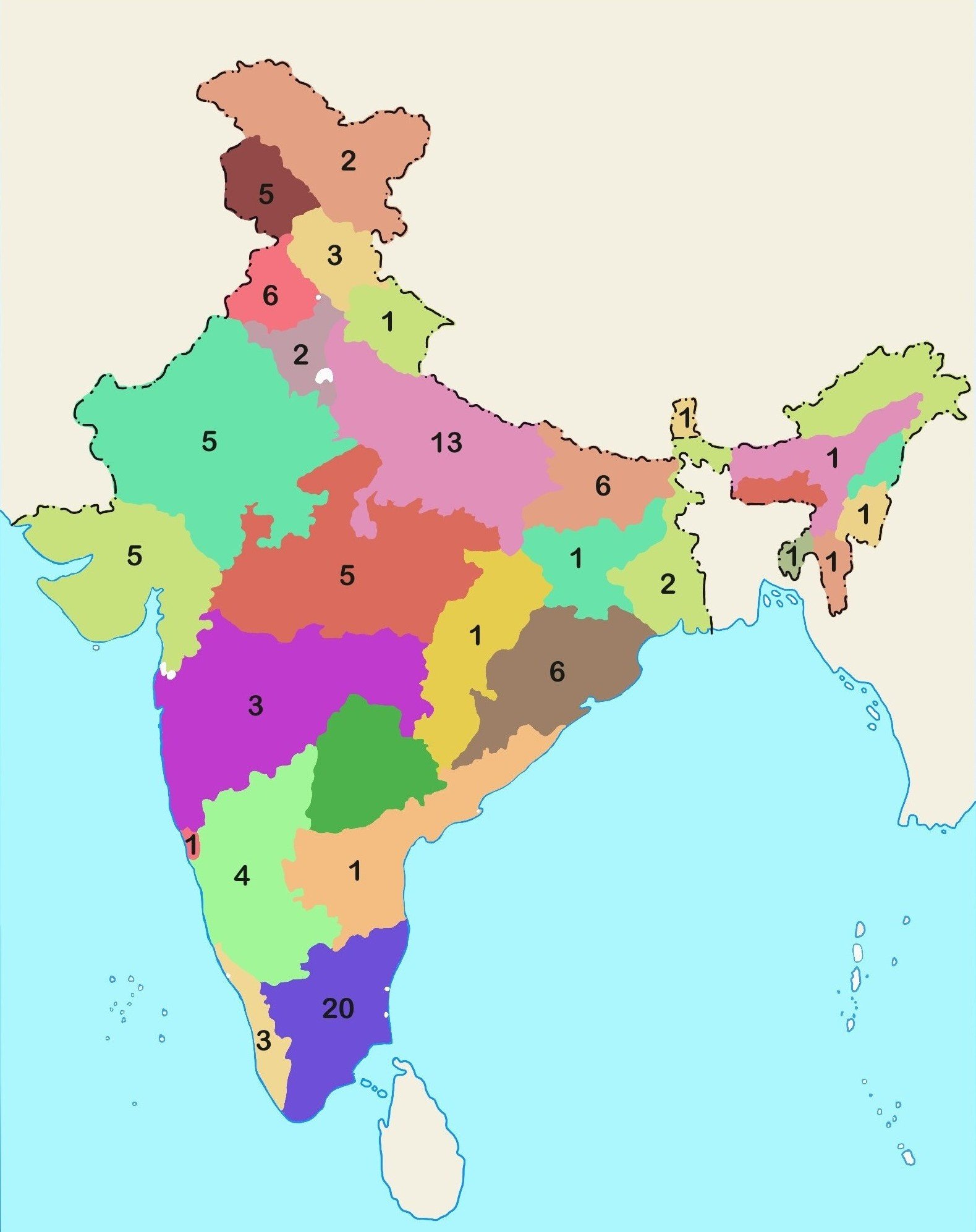
Table: State-wise distribution of Ramsar sites in India
| State/UT | No. of sites | Name of site |
|---|---|---|
| Andhra Pradesh | 1 | Kolleru Lake |
| Assam | 1 | Deepor Beel |
| Chhattisgarh | 1 | Kopra Reservoir |
| Bihar | 6 | Gogabeel Lake, Gokul Reservoir, Kanwar Lake, Nagi Bird Sanctuary, Nakti lake, Udaypur Lake |
| Goa | 1 | Nanda Lake |
| Gujarat | 5 | Chhari-Dhand (2026), Khijadiya, Nalsarovar, Thol Lake, Wadhvana Wetland |
| Haryana | 2 | Sultanpur National Park, Bhindawas Wildlife Sanctuary |
| Himachal Pradesh | 3 | Chandra Taal, Pong Dam Lake Wildlife Sanctuary, Renuka Lake |
| Jammu and Kashmir | 5 | Hokersar Wetland, Hygam Wetland Conservation Reserve, Shallabugh Wetland, Mansar-Surinsar Wildlife Sanctuary, Wular Lake |
| Jharkhand | 1 | Udhwa Lake |
| Karnataka | 4 | Ranganathittu Bird Sanctuary, Ankasamudra Bird Conservation Reserve, Aghanashini Estuary, Magadi Kere Conservation Reserve |
| Kerala | 3 | Ashtamudi Wetland, Sasthamkotta Lake, Vembanad-Kol Wetland |
| Ladakh | 2 | Tso Kar, Tsomoriri Lake |
| Madhya Pradesh | 5 | Bhoj Wetland, Sakhya Sagar, Sirpur Lake, Yashwant Sagar, Tawa Reservoir |
| Maharashtra | 3 | Lonar Lake, Nandur Madhameshwar, Thane Creek |
| Manipur | 1 | Loktak Lake |
| Mizoram | 1 | Pala Wetland |
| Odisha | 6 | Ansupa Lake, Bhitarkanika Mangroves, Chilika Lake, Hirakud Reservoir, Satkosia Gorge, Tampara Lake |
| Punjab | 6 | Beas Conservation Reserve, Harike Wetland, Kanjli Wetland, Keshopur-Miani Community Reserve, Nangal Wildlife Sanctuary, Ropar Wetland |
| Rajasthan | 5 | Keoladeo National Park, Sambhar Lake, Khichan Wetland, Menar Wetland Complex, Silisereh Lake |
| Sikkim | 1 | Khecheopalri Wetland |
| Tamil Nadu | 20 | Chitrangudi Bird Sanctuary, Gulf of Mannar Marine Biosphere Reserve, Kanjirankulam Bird Sanctuary, Karaivetti Bird Sanctuary, Karikili Bird Sanctuary, Koonthankulam Bird Sanctuary, Longwood Shola Reserve Forest, Pallikarnai Marsh Reserve Forest, Pichavaram Mangrove, Point Calimere Wildlife and Bird Sanctuary, Suchindram Theroor Wetland Complex, Udhayamarthandapuram Bird Sanctuary, Vadavur Bird Sanctuary, Vedanthangal Bird Sanctuary, Vellode Bird Sanctuary, Vembannur Wetland Complex, Nanjarayan Bird Sanctuary, Kazhuveli Bird Sanctuary, Sakkarakottai Bird Sanctuary, Therthangal Bird Sanctuary |
| Tripura | 1 | Rudrasagar Lake |
| Uttar Pradesh | 13 | Jai Prakash Narayan Bird Sanctuary (2026), Shekha Jheel Bird Sanctuary (2026), Patna Bird Sanctuary (2026), Bakhira Sanctuary, Haiderpur Wetland, Nawabganj Bird Sanctuary, Parvati Arga Bird Sanctuary, Saman Bird Sanctuary, Samaspur Bird Sanctuary, Sandi Bird Sanctuary, Sarsai Nawar Jheel, Sur Sarovar, Upper Ganga River |
| Uttarakhand | 1 | Asan Barrage |
| West Bengal | 2 | East Kolkata Wetlands, Sundarban Wetland |
| Total | 100 | DOWNLOAD OFFICIAL LIST OF RAMSAR SITES OF INDIA |
Benefits of Wetlands for India
Wetlands provide four major ecosystem services — provisioning, regulating, supporting, and cultural.
- Flood Control: Wetlands absorb excess rainfall and reduce flood peaks in major river basins like the Ganga and Brahmaputra.
- Water Security: They recharge groundwater aquifers critical for irrigation and drinking water in agrarian states.
- Water Purification: Wetlands remove nutrients (nitrogen, phosphorus), sediments, and heavy metals, acting as natural bio-filters.
- Biodiversity Conservation: India lies on the Central Asian Flyway. Wetlands host migratory birds from Siberia and Central Asia. Example: Keoladeo National Park.
- Livelihood Support: Supports inland fisheries, lotus farming, aquaculture, eco-tourism, and salt production.
- Carbon Sequestration: Mangroves and peatlands store large amounts of “blue carbon”. Example: Sundarbans Wetland.
- Climate & Disaster Resilience: Wetlands buffer cyclones (coastal mangroves), mitigate drought impacts, and stabilise micro-climates.
- Alignment with SDGs: Healthy wetlands support SDG 6 (Clean Water & Sanitation), SDG 8 (Sustainable Livelihoods), SDG 13 (Climate Action), SDG 14 (Life Below Water), and SDG 15 (Life on Land).
Threats to Wetlands in India
Despite ecological importance, wetlands are declining rapidly.
- Urbanisation and Encroachment: Real estate expansion and infrastructure projects shrink wetland area.
- Pollution and Sewage Discharge: Untreated wastewater causes eutrophication and fish mortality.
- Hydrological Alteration: Dams, barrages, and river interlinking projects modify natural water regimes.
- Invasive Species: Water hyacinth (Eichhornia), Salvinia block sunlight and reduce dissolved oxygen.
- Agricultural Runoff: Fertilisers and pesticides lead to algal blooms.
- Climate Change: Irregular rainfall, glacial melt, sea-level rise threaten coastal and Himalayan wetlands.
- Over-exploitation: Overfishing, sand mining, excessive water withdrawal degrade ecosystems.
Government Efforts for Conserving Wetlands in India
India has strengthened wetland governance through legal and institutional frameworks.
- Wetlands (Conservation and Management) Rules, 2017: Provide a regulatory framework and prohibit activities like encroachment and waste dumping.
- National Plan for Conservation of Aquatic Ecosystems (NPCA): Centrally Sponsored Scheme for restoration of wetlands and lakes.
- National Wetland Inventory & Assessment (NWIA): Conducted by ISRO’s Space Applications Centre for mapping wetlands.
- State Wetland Authorities: Mandated under 2017 Rules for identification and management.
- Amrit Dharohar Scheme (2023): Focuses on conservation and livelihood enhancement at Ramsar sites.
- World Wetlands Day (2 February): Annual awareness campaigns across states.
Suggestions for Wetland Conservation in India
- Integrated River Basin Management: Manage wetlands within basin-level planning frameworks.
- GIS and Remote Sensing Monitoring: Annual satellite-based wetland mapping.
- Real-Time Water Quality Sensors: IoT-based monitoring systems in Ramsar sites.
- Invasive Species Utilisation: Convert biomass into compost, bio-CNG, or handicrafts.
- Strengthen Urban Wetland Protection: Mandatory buffer zones and STPs for cities.
- Community Participation: Involve local communities in monitoring and sustainable harvesting.
- Strict Implementation of Wetland Rules 2017: Boundary demarcation and enforcement against encroachment.
Wetlands are nature-based solutions that support water security, biodiversity conservation, and climate resilience. Strengthening their protection through scientific management, community participation, and effective governance is essential for ensuring sustainable development and long-term ecological security in India.
Related Articles