
Economy · 6 minutes read
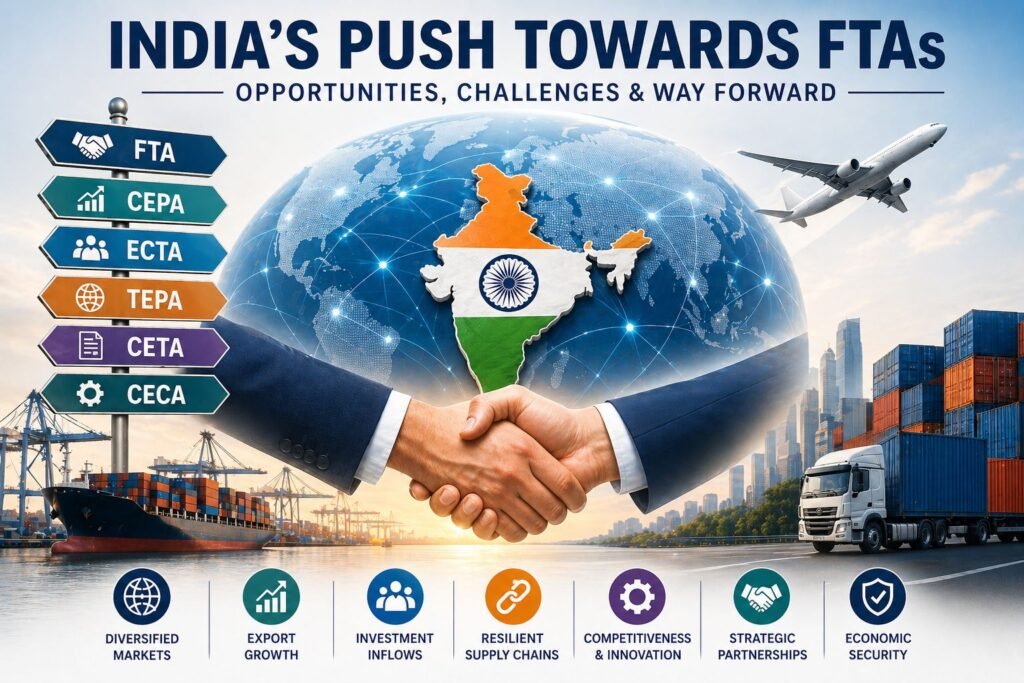
Image source: AI-generated illustration
Introduction
A Free Trade Agreement (FTA) is a pact between two or more countries that reduces or removes tariffs and other trade barriers so goods and services can move more easily between them. FTAs usually focus on trade in goods and services, and many also include rules on investment, intellectual property, government procurement, and dispute settlement. In practice, they aim to make cross-border trade cheaper and simpler rather than completely unregulated.
List of India’s FTAs
As of 27 April 2026, India has signed 18 Free Trade Agreements (FTAs).
Note: In India’s official classification, CECA, CEPA, ECTA and TEPA are variants of FTAs, differing in scope and depth.
| S. No. | Name of the Agreement | Year of Signing | Status |
| 1 | India-Bhutan Agreement on Trade Commerce and Transit | 1972 | Active |
| 2 | India-Sri Lanka FTA | 1998 | Active |
| 3 | India-Thailand FTA – Early Harvest Scheme (EHS) | 2003 | Active |
| 4 | Agreement on SAFTA | 2004 | Active |
| 5 | India-Singapore Comprehensive Economic Cooperation Agreement (CECA) | 2005 | Active |
| 6 | India-Nepal Treaty of Trade | 2009 | Active |
| 7 | India-South Korea Comprehensive Economic Partnership Agreement (CEPA) | 2009 | Active |
| 8 | India-ASEAN Comprehensive Economic Cooperation Agreement (CECA) — Trade in Goods, Services and Investment Agreement | 2009 – for goods 2014 – for services and investment | Active |
| 9 | India-Japan Comprehensive Economic Partnership Agreement (CEPA) | 2011 | Active |
| 10 | India-Malaysia Comprehensive Economic Cooperation Agreement (CECA) | 2011 | Active |
| 11 | India-Mauritius Comprehensive Economic Cooperation and Partnership Agreement (CECPA) | 2021 | Active |
| 12 | India-UAE Comprehensive Economic Partnership Agreement (CEPA) | 2022 | Active |
| 13 | India-Australia Economic Cooperation and Trade Agreement (ECTA) | 2022 | Active |
| 14 | India-EFTA Trade and Economic Partnership Agreement (TEPA) | 2024 | Active |
| 15 | India-UK Comprehensive Economic and Trade Agreement (CETA) | 2025 | not yet implemented |
| 16 | India–Oman Comprehensive Economic Partnership Agreement (CEPA) | 2025 | not yet implemented |
| 17 | India–EU FTA | 2026 | not yet implemented |
| 18 | India-New Zealand FTA | 2026 | not yet implemented |
Benefits of FTAs for India
FTAs provide India with opportunities to expand exports, attract investment, and enhance competitiveness across sectors.
- Tariff Reduction and Cost Efficiency: FTAs reduce or eliminate customs duties on goods, lowering input costs for domestic industry (e.g., duty cuts on electronics components under India–ASEAN FTA support assembly manufacturing).
- Enhanced Trade: Preferential tariffs make Indian goods cheaper in partner markets, boosting exports. For example, India–UAE CEPA helped push bilateral merchandise trade to about $100.1 billion in FY25, an increase from about $43.3 billion in FY 2020–21, with India’s exports to the UAE rising significantly
- Market Expansion and Diversification: FTAs open access to new geographies, reducing dependence on traditional markets (e.g., UAE CEPA and Australia ECTA diversify India’s trade towards West Asia and Indo-Pacific).
- Integration into Global Value Chains (GVCs): Lower trade barriers enable smoother import of intermediates and export of finished goods (e.g., auto components and electronics sectors linked with ASEAN supply chains).
- Investment Attraction: Stable trade regimes improve investor confidence (e.g., UAE has emerged among top FDI sources, contributing ~3–4% of India’s cumulative FDI inflows).
- Trade Facilitation and Customs Efficiency: Modern FTAs streamline procedures through digital documentation and faster clearances (e.g., paperless trade and simplified customs norms under UAE CEPA).
- Access to Services Markets: FTAs create openings for Indian professionals (e.g., Australia ECTA facilitates mobility for chefs, yoga instructors, and contractual service providers).
- Consumer Welfare and Price Stability: Reduced tariffs increase availability of affordable imports (e.g., cheaper edible oils, electronics, and industrial inputs helping moderate input costs).
- Productivity and Efficiency Gains: Exposure to global competition drives technological upgradation (e.g., Indian auto sector aligning with global quality and emission standards post integration).
- MSME Export Opportunities: Preferential access supports MSMEs (e.g., textile and handicraft exporters using UAE as a re-export hub to West Asia and Africa).
- Employment Generation: Export-led sectors generate jobs (e.g., textiles and gems & jewellery together employ millions, with exports supported by preferential market access).
- Strategic and Geopolitical Gains: FTAs strengthen economic diplomacy (e.g., CEPA/ECTA agreements align with India’s Indo-Pacific and West Asia outreach strategies).
Challenges of FTAs for India
While FTAs aim to boost trade, investment, and global integration, India’s experience shows asymmetrical outcomes, especially in goods trade and domestic sectoral impacts.
- Persistent Trade Deficits: India has recorded rising trade deficits with several FTA partners (e.g., ASEAN, South Korea). Imports of electronics, machinery, and intermediates often outpace export growth due to competitiveness gaps.
- Rules of Origin (RoO) Misuse: Third-country goods may enter India through FTA partners by minimal value addition (trade deflection), e.g. Chinese goods routed via ASEAN economies.
- Pressure on Sensitive Sectors: Agriculture and dairy remain highly vulnerable due to subsidized imports in developed countries. India has resisted market access demands in EU and New Zealand FTA negotiations.
- Limited Gains in Services Trade: India’s strength lies in services, but FTAs yield modest progress in Mode 4 (movement of professionals). Visa regimes and domestic regulations in partner countries restrict IT and skilled workforce mobility.
- Intellectual Property (IPR) Pressures: Developed partners push for TRIPS-plus provisions (data exclusivity, patent extensions). These may constrain India’s generic pharmaceutical industry and compulsory licensing flexibility.
- Compliance Burden on MSMEs: Small exporters face challenges in meeting Rules of Origin certification, standards, and documentation. High compliance costs reduce their ability to utilise FTA benefits effectively.
- Reduced Tariff Policy Space: FTAs involve binding tariff commitments, limiting flexibility to raise duties later. Though safeguards exist, policy space for protecting domestic industry becomes narrower.
- Negotiation delays: Complex inter‑governmental bargaining and concerns from farmers, dairy cooperatives, and MSMEs about livelihood impacts can slow down FTA negotiations.
- Geopolitical Constraints: Regional agreements like SAFTA remain underutilised due to political tensions, especially India–Pakistan relations.
Way Forward
To maximise gains and minimise risks, India must shift towards a strategic, calibrated, and capability-driven FTA approach aligned with domestic economic priorities.
- Focus on Quality over Quantity: India should prioritise strategically important FTAs rather than signing multiple shallow agreements (e.g., targeted deals like UAE CEPA and Australia ECTA).
- Strengthen Domestic Competitiveness: Improve manufacturing efficiency through PLI schemes, logistics reforms (Gati Shakti), and ease of doing business to compete effectively with imports.
- Simplify Rules of Origin Compliance: Streamline certification and reduce procedural burden to improve FTA utilisation rates (currently low in many agreements), especially for MSMEs.
- Prioritise Services and Mobility Gains: Negotiate stronger provisions on Mode 4 (movement of professionals) and mutual recognition agreements (e.g., skills mobility under Australia ECTA).
- Protect Sensitive Sectors: Use calibrated tariff liberalisation, safeguard clauses, and exclusion lists for agriculture and dairy (e.g., cautious stance in EU FTA talks).
- Strengthen Trade Defence Mechanisms: Actively use anti-dumping duties, countervailing duties, and safeguard measures to address unfair trade practices.
- Build Negotiation Capacity: Develop specialised expertise in trade law, economics, and sectoral analysis to improve bargaining outcomes in complex FTAs.
- Promote MSME Integration: Provide support for standards compliance, digital trade access, and export financing to increase MSME participation in FTA benefits.
- Leverage FTAs for GVC Integration: Align trade policy with industrial strategy to integrate into global value chains (e.g., electronics, semiconductors, auto components).
- Deepen Strategic Partnerships: Use FTAs as tools of economic diplomacy to strengthen ties in Indo-Pacific, West Asia, and Europe (e.g., CEPA/ECTA framework).
India’s renewed push towards FTAs is shaped by the evolving landscape of global trade and geopolitics. By securing diversified markets and more resilient supply chains through FTAs, India can reduce external vulnerabilities, stabilise trade flows, and position itself as a reliable hub for global manufacturing and services in an increasingly uncertain world.