
News Summary · 4 minutes read
Stay ahead in your UPSC CSE preparation with our daily News Summary. Designed to save time, it highlights key national and international events from leading newspapers and government websites.
India receives final batch of Apache helicopters
- Indian Army has received the final batch of three AH-64E Apache attack helicopters → completes the 6-unit fleet of Army’s dedicated Apache squadron in Jodhpur.
- Apache helicopters were contracted in 2020 under a $600-million deal with the United States.
- AH-64E Apache is regarded as the world’s most advanced multi-role combat helicopter.
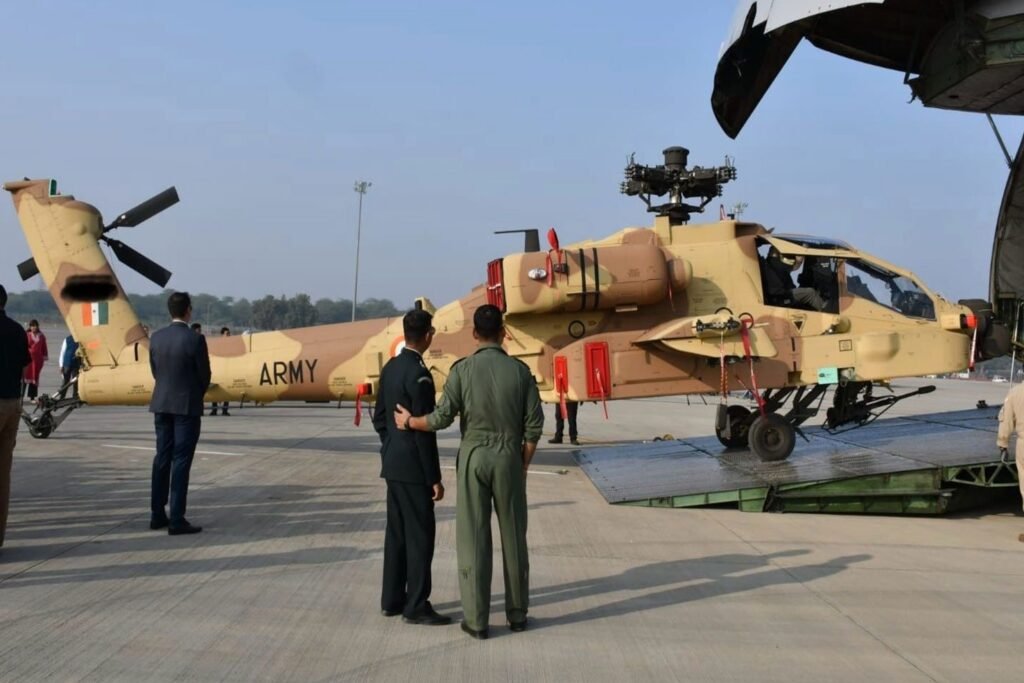
An AH-64E Apache attack helicopter at Hindon Air Force Station in Ghaziabad. Photo: X/@ani_digital
MHA approves project for community-led disaster management in panchayats
- A ₹507.37 crore scheme named “National Project on Strengthening Community Based Disaster Risk Reduction (CBDRR) Initiatives in Panchayati Raj Institutions.”
- Launched in collaboration with the Ministry of Panchayati Raj and National Disaster Management Authority (NDMA).
- Extends the National Disaster Mitigation Fund (NDMF), launched in 2021, to panchayats.
- Covers 81 disaster-prone districts across 20 states → aims to develop 20 model Gram Panchayats in disaster management.
- Funding will be shared between the Centre and the States.
Maoist insurgency in India: causes, government interventions, and way forward
Maoist insurgency in India began with the Naxalbari uprising (1967) in West Bengal and peaked in the late 2000s. Sustained security operations, infrastructure expansion, and welfare outreach have sharply reduced its footprint. In 2025, Maoist influence has reduced to around 11 districts across India, down from 126 in 2013. India aims to eliminate Maoist insurgency by March 2026.
Causes
Socioeconomic issues
- Loss of land and reduced access to forests, especially after economic liberalisation, severely affected the livelihoods and dignity of tribals.
- Poor access to health and education marginalised tribals in the development process of India.
- Poverty and lack of infrastructure led to the acute material deprivation among vulnerable tribal populations.
Governance and administrative failure
- Administrative exclusion of Adivasis: governance institutions and bureaucracy have been dominated by non-tribal people, who could not understand the specific needs of the tribals.
- Fifth Schedule areas became the hotbed of Maoist insurgencies because authorities failed to operationalise the safeguards for tribals provided therein.
- Planning Commission Expert Committee (2008) highlighted that resource-rich tribal regions were reduced to penury due to governance failure.
- Violation of forest and land rights:
- Violations of PESA, 1996, undermined theself-governance.
- Provisions of the Forest Rights Act (FRA), 2006, have been ignored to unlock mineral resources.
- Compensatory Afforestation Fund (CAF) Act, 2016, negatively affected tribal livelihoods.
Failure of oversight institutions
- The Ministry of Tribal Welfare and the National Commission for Scheduled Tribes failed to prevent the exploitation of tribals.
- Mungekar Committee (2009) highlighted institutional ineffectiveness.
- Police, forest department, revenue administration, and judiciary failed to assist tribals in securing their legitimate rights → led to dissatisfaction and loss of trust in State machinery.
Maoists exploited governance and development gaps in tribal regions to:
- Establish parallel systems of so-called speedy justice (kangaroo courts).
- Mobilise tribals around the slogan of Jal, Jungle and Zameen and brainwash them to overthrow government authorities to establish Maoist rule.
Government efforts to combat Maoist insurgency
India has adopted a multi-pronged approach to tackle Naxalism, such as follows:
- SAMADHAN strategy (2017): combines both security and developmental needs of Left-Wing Extremism (LWE) affected regions.
- Security interventions, e.g., Operation Black Forest (2025).
- Developmental approach such as Eklavya Model Residential Schools (1997-98) and ROSHNI scheme (2013).
- Governance reforms to safeguard tribal rights,e.g., PESA (1996) and FRA (2006).
- Rehabilitation of those who leave LWE violence and join mainstream society,e.g., Surrender-cum-Rehabilitation Policy (2014).
Way Forward
- Improving the functioning of institutions such as the police, forest department, revenue department, and judiciary → to address the trust issues among tribals against the state machinery.
- Ensuring participation of tribals in the administrative decision-making.
- Rights-based laws such as FRA 2006 and PESA 1996 should be strengthened and implemented correctly.
- Autonomous governance models for 5th Schedule Areas should be explored, akin to 6th Schedule Tribal Areas.
- Improving the health and education among the tribal population.
Rules for creating and renaming districts
- States hold exclusive authority to create, alter, or abolish districts via executive order or state assembly legislation, without central govt involvement.
- States require Union Home Ministry approval for district name changes, involving ‘no-objection’ certificates from agencies like Railways, Posts, Survey of India, and Intelligence Bureau → ensures coordination across national records and services.
Quick Picks for Pre and Mains (QPPM)
- The Indian Rupee has depreciated 91.14 against the U.S. dollar to become the weakest currency in Asia in 2025.
- In 2025, many children contracted HIV in Madhya Pradesh and Jharkhanddue to contaminated blood transfusions while being treated for thalassaemia.
- India has lost nearly ₹3,000 crore to scammers through ‘digital arrests’ (highlighted by Central govt in Supreme court).
- Param Vir Chakra (PVC) is India’s highest military honour, awarded for exceptional acts of valour or self-sacrifice → 21 PVCs have been awarded so far → can be given to living persons or posthumously.
- India and Jordan have signed a twinning agreement between Petra and the Ellora Caves to promote tourism and heritage links → both are famous for rock-cut architecture and included in the list of UNESCO World Heritage sites.
- EKUVERIN: bilateral military exercise between Indian Army and the Maldives National Defence Forces (MNDF) → recently concluded in Thiruvananthapuram.
- Uvira city: DR Congo (near its border with Burundi)
- Bondi Beach: Sydney, Australia.