
News Summary · 6 minutes read
Stay ahead in your UPSC CSE preparation with our daily News Summary. Designed to save time, it highlights key national and international events from leading newspapers and government websites.
Contents
hide
Kaziranga Elevated Corridor Project
- Recently, its foundation stone was laid by PM Modi in Kaliabor (Nagaon, Assam).
- Designed in compliance with Supreme Court directions and the recommendations of the Wildlife Institute of India.
- 86 km long corridor on National Highway-715 → includes 35 km long elevated wildlife corridor that aims to:
- Ensure safe wildlife movement across the Kaziranga National Park and Tiger Reserve
- Reduce road accidents,
- Boost ecotourism
- Generate local employment.
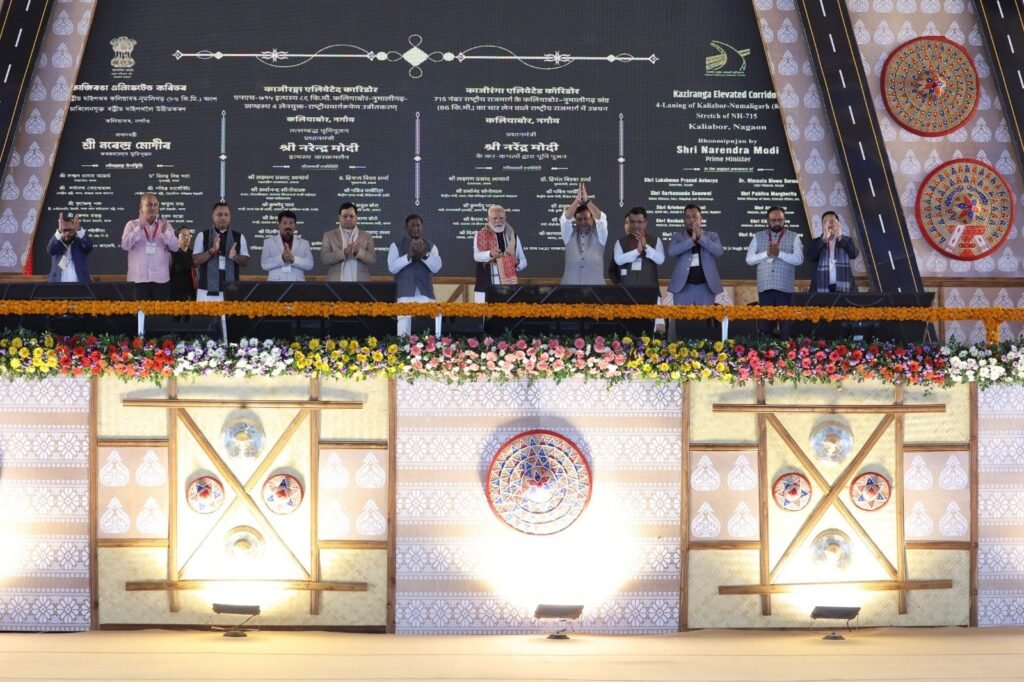
PM Modi Laying the foundation stone for the Kaziranga Elevated Corridor Project on 18 January 2026 in Kaliabor, Assam: X/@narendramodi
Kaziranga National Park & Tiger Reserve
- Located in the Brahmaputra floodplains, with Brahmaputra in the north and the Karbi Anglong hills in the south.
- Has rich biodiversity:
- Hosts world’s largest population of one-horned rhinoceroses, along with tigers, elephants, wild water buffalo, swamp deer, panthers, bears, and pythons.
- 4 main types of vegetation: alluvial inundated grasslands, alluvial savanna woodlands, tropical moist mixed deciduous forests, and tropical semi-evergreen forests.
- Declared as a National Park in1974, a UNESCO World Heritage Site in1985, and a Tiger Reserve in2006.
National Intelligence Grid (NATGRID)
- A secure data‑access platform under the Home Ministry.
- Conceptualised in 2009 in the aftermath of the 26/11 Mumbai terror attacks → became operational in 2020.
- Accessible to the authorised central security agencies (IB, RAW, NIA, ED, FIU, NCB, DRI, etc.) and SP‑rank State police officers.
- Provides information on 20+ datasets including:
- Banking and financial transactions
- Tax and PAN data
- Passport and immigration records
- Airline and rail bookings
- Vehicle registration, driving licences, and toll/FASTag payments
- Telecom records
- Social‑media metadata
- Crime records
- Offers single‑window access to FIRs and crime records from 17,000+ police stations across India through integration with Crime and Criminal Tracking Network & Systems (CCTNS).
- Supports investigations into terrorism and terror financing, organised crime, financial crimes, narcotics, cybercrime, human trafficking, smuggling, and related national‑security threats.
Section 17A, Prevention of Corruption (PC) Act, 1988
- Inserted via the 2018 Amendment to the PC Act, 1988.
- Mandates prior approval from the competent authority before police can initiate proceedings against a public servant accused of offences under the PC Act 1988 for actions done in an official capacity.
- Aims to prevent frivolous probes and protect honest officers from harassment.
- Competent authority must approve or disapprove the proposal to start proceedings within 3 months (extendable by one month with recorded reasons).
- Competent authority means an authority that is empowered to remove an officer from her office, e.g., Central govt for Union/AIS employees and State govt for State employees.
Child trafficking in India
The Palermo Protocol (2000) of the United Nations defines child trafficking as ‘the recruitment, transportation, transfer, harbouring, or receipt of a child for the purpose of exploitation.’ Also, Section 143 of Bhartiya Nyaya Sanhita (BNS) 2023 provides a comprehensive definition of child trafficking for exploitation.
Current scenario
Child trafficking remains a deeply disturbing reality in India:
- According to the NCRB 2023 data, 6,288 victims were trafficked in 2023, of which nearly 43% (2687) were children (below 18 years).
- Conviction rate for child trafficking offences between 2018 and 2022 was only 4.8%.
Challenges
- India’s society, education system, and police administration face significant gaps in providing children with the care, protection and guidance that can prevent them from being victims of trafficking.
- Poverty, unemployment, migration, disasters and breakdown of the family system make children vulnerable to trafficking.
- Traffickers misuse social media and online platforms to lure children for fake opportunities related to earning money, entertainment, or getting famous.
Constitutional and legal provisions
- Article 23: protects children from trafficking and forced labour.
- Article 24: prohibits employment of children in hazardous industries.
- Article 39(f): children should be protected from exploitation and moral and material abandonment.
- Sections 98 & 99, BNS: address the ‘selling and buying’ of minors.
- Immoral Traffic (Prevention) Act, 1956: addresses child trafficking for sexual exploitation.
- Juvenile Justice (Care and Protection of Children) Act, 2015: care, protection and rehabilitation for victims of child trafficking.
- Criminal Law Amendment Act, 2013: defines trafficking comprehensively.
- Protection of Children from Sexual Offences (POCSO) Act, 2012: provides for stringent punishments like life imprisonment and death penalty if trafficking involves sexual exploitation of children.
Judicial Interventions
- Vishal Jeet v. UOI (1990): held that child trafficking is a serious socio-economic problem and directed a preventive and humanistic approach to deal with it.
- M.C. Mehta v. Tamil Nadu (1996): issued guidelines to prohibit child labour in hazardous industries.
- Bachpan Bachao Andolan v. UOI (2011): directed the government to address widespread child trafficking.
- K.P. Kiran Kumar v. State (2025): held that trafficking violates children’s fundamental right to life (Article 21) and a minor victim’s testimony against the offender cannot be rejected on the basis of minor inconsistencies.
Govt efforts
- Ujjawala Scheme of Women and Child Development Ministry provides shelter homes and vocational training to rescued children.
- Integrated Child Protection Scheme (ICPS) strengthens child protection mechanisms, including anti-trafficking measures at district levels.
- Home Ministry mandated (2022) Anti-Human Trafficking Units (AHTUs) in all districts.
- National Commission for Protection of Child Rights (NCPCR) runs campaigns, e.g., Combating Child Trafficking (2022).
- India ratified UN’s Palermo Protocol in 2011 → covers child trafficking issue.
- India has signed MoUs with Bangladesh, the UAE, and Cambodia to prevent transnational child trafficking.
Way forward
- Govt should take measures to increase the conviction rate of traffickers to create a deterrence effect.
- Better Centre-State and State-State coordination is required because law and order and police are State subjects, and child traffickers have interstate networks.
- NATGRID and CCTNS should be leveraged for the prevention and investigation of these crimes.
- Govt should collaborate with civil society groups and NGOs to run offline and online awareness campaigns for empowering children against the traps created by traffickers.
- Govt must ensure effective implementation of anti-trafficking laws.
- Rehabilitation of the victims must be ensured, including their education, medical care, and financial support.
Power distribution utilities record profit
- India’s power distribution utilities have recorded a Profit After Tax (PAT) of ₹ 2,701 crore in FY 2024-25 → primarily led by State-run discoms.
- A significant improvement compared to a loss of ₹ 67,962 crore in FY 2013-14.
- Aggregate Technical and Commercial losses, an indicator of losses because of technical inefficiencies, theft, billing inefficiencies, and commercial losses combined, have reduced to 15.04% in FY 2024-25 from 22.62% in FY 2013-14.
Quick Picks for Pre and Mains (QPPM)
- Guillain-Barré Syndrome (GBS): a rare autoimmune disorder where the immune system mistakenly attacks the peripheral nerves, leading to muscle weakness, tingling, and potential paralysis → recently GBS cases have been detected in Neemuch, MP.
- European Union and Mercosur have signed a Free Trade Agreement.
- Mercosur is a South American trade bloc having 6 State Parties:Argentina, Bolivia, Brazil, Paraguay, Uruguay, and Venezuela (suspended).
- Tabqah city: Raqqa province, Syria.